Why Indian Brands Ranking on Google Are Investing in PR, Not Just SEO
Indian brands ranking on Google are investing in PR alongside SEO. Learn how earned media, brand authority, and trust signals now drive sustainable search rankings.
Digital PR Changes Fundamentally
Is Traditional PR Still Relevant?
How Brand Discovery Has Shifted
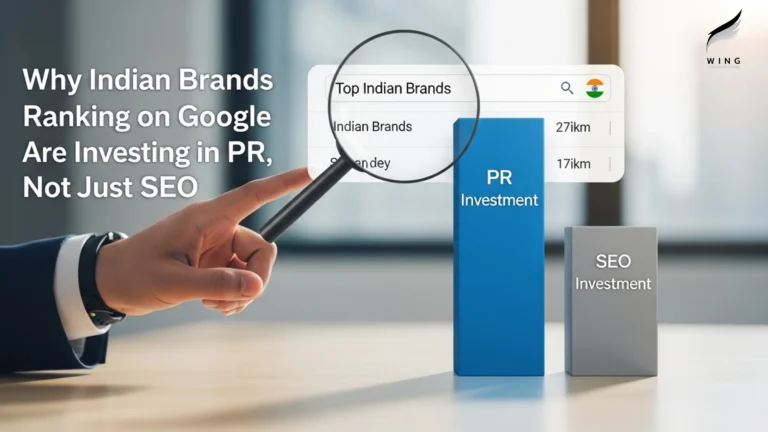
For nearly a decade, SEO was the primary lever Indian brands pulled to win visibility on Google.
The formula felt predictable: identify keywords, optimise pages, publish blogs, build backlinks, and watch rankings improve. For many businesses—especially in the early 2010s—this approach worked remarkably well.
But in 2026, that playbook is no longer enough.
Across industries in India—fintech, SaaS, healthcare, D2C, enterprise services—the brands that consistently rank on Google are doing something fundamentally different. They are investing in PR alongside SEO, not as a branding exercise, but as a core input into search authority, trust, and long-term visibility.
This shift is not accidental. It is a response to how search engines, audiences, and credibility now work together.
Google Has Moved Beyond Pages to Brands
At its core, Google’s mission has not changed: deliver the most trustworthy and relevant results to users.
What has changed is how trust and relevance are evaluated.
Search algorithms today assess far more than:
- Keyword placement
- Page speed
- Metadata
- Technical structure
They increasingly look at brand-level signals, including:
- How often a brand is mentioned across the web
- Which publications reference it
- Whether those mentions are consistent and contextual
- How users search for and interact with the brand
In other words, Google is no longer just ranking pages.
It is ranking entities—brands with perceived authority and credibility.
SEO can optimise a page.
PR builds the authority of the entity behind that page.
Book Free Strategy Call
Why SEO Alone Is Hitting a Ceiling for Indian Brands
Many Indian brands encounter the same frustration.
They invest in:
- Clean technical SEO
- High-quality content
- Regular publishing
- Standard backlink strategies
Initially, rankings improve. Then progress slows. Eventually, growth stalls.
At this stage, brands often notice something uncomfortable:
Competitors with weaker on-page SEO but stronger brand presence begin to outrank them.
This happens because when Google compares two similarly optimised results, it favours the brand that:
- Is more widely referenced
- Is discussed by credible third parties
- Has stronger branded search demand
- Appears more “real” beyond its own website
These signals are not produced by SEO tools.
They are the by-product of PR and earned visibility.
PR as a Search Authority Engine
PR improves Google rankings not by manipulating algorithms, but by shaping how authority is perceived across the web.
Consistent, credible media coverage contributes to search performance in several interconnected ways.
First, it generates editorial backlinks from high-authority publications. These links are contextually embedded, long-lasting, and trusted—very different from manufactured link-building tactics.
Second, it creates brand mentions, even when links are not present. Search engines increasingly recognise unlinked mentions as signals of entity prominence and topical relevance.
Third, it reinforces topical authority. When a brand repeatedly appears in discussions about a specific industry, problem space, or trend, search engines associate it more strongly with those topics.
Over time, these signals accumulate. SEO efforts placed on top of this foundation perform significantly better.
Brand Mentions and Entity Recognition
One of the most misunderstood aspects of modern search is the role of brand mentions.
Google no longer relies only on hyperlinks to understand importance. Repeated mentions of a brand across credible websites help search engines:
- Confirm that the brand exists beyond its own domain
- Associate it with specific industries or themes
- Distinguish it from low-credibility or short-lived entities
PR accelerates this process by placing brands in the right editorial environments—business publications, industry platforms, expert commentary, and analysis pieces.
This is particularly important in India, where new companies emerge rapidly and credibility gaps are common. Media coverage acts as an external verification layer.
PR and E-E-A-T: A Natural Alignment
Google’s emphasis on Experience, Expertise, Authoritativeness, and Trust (E-E-A-T) aligns almost perfectly with PR outcomes.
SEO can demonstrate expertise through content.
But authoritativeness and trust are far harder to self-assert.
PR provides:
- Founder and leadership interviews
- Expert commentary in credible publications
- Industry insights validated by editors
- Third-party discussion of a brand’s work and impact
These are signals SEO cannot fabricate. They must be earned.
For Indian brands operating in regulated or trust-sensitive sectors—such as fintech, healthcare, enterprise technology, or B2B services—this external validation often determines whether rankings are sustained or lost.
Branded Search: The Overlooked Ranking Signal
One of the strongest indicators of brand relevance is branded search demand.
When people actively search for a company by name, Google interprets this as real-world interest and trust. Brands that are searched for tend to:
- Rank faster
- Maintain rankings longer
- Recover more easily from algorithm updates
PR plays a direct role here.
When a brand appears in credible media:
- Readers search for it
- Stakeholders validate it
- Awareness turns into intent
SEO captures this demand.
PR creates it.
This is why brands with consistent PR presence often outperform competitors in both branded and non-branded queries.
The Compounding Effect of PR-Led Authority
Unlike many SEO tactics, PR-driven authority does not reset each month.
Each credible mention:
- Strengthens brand recognition
- Improves trust signals
- Makes future content easier to rank
Over time, this creates a compounding advantage.
This is why Indian brands that invest early in PR often find that:
- Their SEO efforts become more efficient
- Their rankings stabilise
- Their dependence on aggressive optimisation decreases
PR becomes search infrastructure, not a parallel activity.
Why Leading Indian Brands Are Aligning PR and SEO
High-ranking Indian brands understand a simple but powerful truth:
SEO works best in an environment of trust.
This is why many are working with digital-first communication firms such as Wingcomm, which approach PR not merely as publicity, but as a system for building long-term credibility and discoverability.
Such approaches ensure that:
- Media narratives reinforce search positioning
- Earned visibility supports keyword authority
- Brand trust compounds across channels
Instead of treating PR and SEO as separate functions, these brands design them as interdependent systems.
PR Is Not Replacing SEO — It Is Enabling It
This shift does not mean SEO is becoming less important.
On the contrary, SEO remains essential for:
- Capturing intent
- Structuring content
- Ensuring technical accessibility
But SEO without PR operates in a vacuum.
PR ensures that when Google evaluates content quality, it sees a brand that:
- Is referenced by others
- Is part of ongoing industry conversations
- Has demonstrated credibility beyond its own claims
What Indian Brands Should Reconsider in 2026
The critical question for Indian brands is no longer:
“How do we rank for more keywords?”
It is:
“Why should Google trust us more than our competitors?”
Answering that requires:
- Consistent earned media
- Clear narrative positioning
- Leadership visibility
- External validation
All of which sit squarely within PR.
A Clear Takeaway
Indian brands ranking on Google are not choosing PR instead of SEO.
They are choosing PR to make SEO effective, resilient, and scalable.
In modern search, optimisation is table stakes.
Authority is the differentiator.
Brands that understand this will not only rank higher —
they will stay ranked, even as algorithms evolve.
Because in today’s search ecosystem, trust is the strongest ranking factor of all.
Proof & Outcomes
Align PR and SEO into a single, scalable growth system
Recognise how PR-led authority compounds SEO impact over time
Identify the role of media coverage in entity recognition and E-E-A-T
FAQs: PR, SEO, and Google Rankings in India
Why are Indian brands investing in PR for Google rankings?
Because Google increasingly ranks brands based on authority, trust, and third-party validation—signals that PR builds more effectively than SEO alone.
Can PR really improve Google rankings?
Yes. PR contributes to editorial backlinks, brand mentions, E-E-A-T signals, and branded search demand, all of which influence organic visibility.
Is SEO still important if a brand invests in PR?
Absolutely. SEO captures demand and structures content, while PR builds the trust environment that allows SEO to perform consistently.
What types of PR impact search rankings the most?
Earned media in credible publications, expert commentary, leadership interviews, and consistent brand mentions in relevant industry contexts.
Book a Free PR Strategy Session
Tell us a bit about your brand and goals. We’ll share a tailored press plan and timeline.