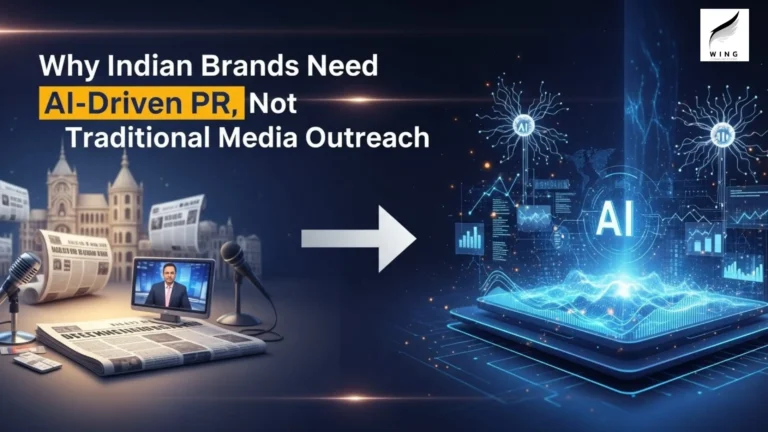
Why Indian Brands Need AI-Driven PR, Not Traditional Media Outreach
Traditional media outreach is no longer enough. Learn why Indian brands need AI-driven PR to manage perception, credibility, and reputation at scale.
Reality of Indian Newsrooms
A Real Story — Not an Announcement
A Real Story — Not an Announcement
For decades, Indian brands relied on a familiar PR playbook.
Draft a press release, send it to a media list, follow up, track coverage, repeat.
That model worked when media was slower, audiences were less fragmented, and perception moved at a human pace.
In 2026, it no longer does.
Indian brands today operate in an environment shaped by algorithms, real-time sentiment, investor scrutiny, and AI-powered discovery. In this reality, traditional media outreach alone is not enough. Brands need PR that is predictive, data-aware, and intelligence-led.
That’s where AI-driven PR becomes essential — not as a trend, but as a structural upgrade.
The Problem With Traditional Media Outreach
Traditional PR is largely reactive.
It waits for news to happen, then communicates. It focuses on distribution over insight and coverage volume over narrative control. In a high-noise ecosystem like India, this approach creates three major risks.
First, brands react too late.
By the time a press release goes out, conversations may already be forming on social platforms, regional media, or investor circles.
Second, messaging lacks precision.
The same pitch is often sent to multiple journalists, regardless of beat relevance, timing, or audience interest.
Third, measurement is backward-looking.
Reports focus on what happened, not what is likely to happen next.
In an ecosystem where perception shifts faster than performance, this lag is costly.
Book Free Strategy Call
How the Indian Media Landscape Has Changed
Indian media is no longer just newspapers, TV channels, and business portals.
Today, brand perception is shaped across:
- Digital-first publications
- Regional and vernacular media
- Social platforms and creator commentary
- Search and AI-generated summaries
- Investor and analyst discussions
Journalists themselves rely on data signals, trends, and audience response to decide what matters. In this environment, PR that doesn’t understand signals is operating blind.
What AI-Driven PR Actually Changes
AI-driven PR does not replace relationships, storytelling, or human judgment.
It strengthens them with intelligence.
Instead of asking “How do we get coverage?”, AI-driven PR asks:
- What narratives are already forming?
- Where is sentiment shifting?
- Which topics are gaining traction with journalists?
- What risks are emerging quietly?
This shift moves PR from execution to anticipation.
From Guesswork to Narrative Intelligence
Traditional PR relies heavily on experience and instinct. While valuable, instinct alone cannot track the scale and speed of modern perception.
AI-driven PR analyzes patterns across media, competitors, and audience conversations to identify narrative gaps and opportunities. This allows brands to speak into the conversation at the right moment — with relevance, not noise.
For Indian brands operating in crowded or regulated sectors, this clarity is critical.
Reputation Management in Real Time
Reputation risk rarely begins with a headline.
It starts with subtle signals — repeated complaints, regional stories, tone shifts, or speculative commentary.
AI-driven PR detects these signals early, allowing brands to respond before narratives harden. This is especially important in India, where regional and language-based media can influence perception long before national coverage appears.
Traditional PR often notices issues after damage has begun.
AI-driven PR notices them while they are still preventable.
Why Traditional Outreach Fails at Scale
As brands grow, scrutiny increases.
Investors expect consistency.
Media expects substance.
Audiences expect transparency.
Traditional outreach struggles here because it focuses on activity, not credibility. It can generate mentions, but it cannot consistently build belief.
AI-driven PR helps brands maintain narrative discipline as visibility increases, ensuring that growth does not amplify risk.
The Strategic Advantage for Indian Brands
AI-driven PR enables Indian brands to:
- Align messaging with real media and audience interest
- Reduce reputational surprises
- Improve leadership credibility over time
- Make PR measurable at a strategic level
This is not about replacing human relationships. It’s about giving those relationships better information, timing, and context.
Traditional PR vs AI-Driven PR: The Real Difference
Traditional PR focuses on distribution.
AI-driven PR focuses on direction.
Traditional PR reports on the past.
AI-driven PR prepares for what’s next.
Traditional PR reacts to narratives.
AI-driven PR helps shape them early.
For brands operating at scale, this difference defines resilience.
The Future of PR in India
PR in India is moving from visibility to belief management.
The brands that will lead in the coming years are not those that speak the loudest, but those that understand the ecosystem best. AI-driven PR gives brands that understanding — without removing the human judgment that makes communication credible.
In a market as complex and fast-moving as India, intelligence is no longer optional.
A Final Thought for Indian Brand Leaders
PR is no longer about who you know in the newsroom or how many releases you can distribute. For Indian brands operating in an environment shaped by algorithms, real-time sentiment, and heightened scrutiny, communication has become a systems problem, not a media task.
Traditional media outreach still has a role — but only as one input. Without intelligence, timing, and narrative awareness, it quickly becomes reactive and inefficient.
This is where approaches like those adopted by Wing Communications reflect a broader shift in the industry — from broadcasting messages to understanding perception. AI-driven PR helps brands see where conversations are heading, not just where they’ve already been. And in markets like India, where scale amplifies both opportunity and risk, that difference matters.
The brands that will lead over the next decade won’t be the loudest.
They’ll be the most aware, consistent, and credible.
PR, when driven by intelligence rather than habit, becomes less about coverage — and more about control.
Proof & Outcomes
Understand why traditional media outreach is no longer sufficient
Identify early reputation and sentiment risks before they escalate
Align PR strategy with modern media, investor, and audience behavior
FAQs: AI-Driven PR vs Traditional PR
What is AI-driven PR?
AI-driven PR uses data and intelligence to monitor narratives, predict sentiment shifts, and guide communication strategy before issues or opportunities fully emerge.
Is traditional PR still relevant in India?
Yes, but only as one component. Traditional outreach without intelligence and narrative awareness becomes reactive and inefficient at scale.
How does AI-driven PR help manage reputation risk?
It detects early signals—sentiment changes, narrative patterns, regional media trends—allowing brands to respond before issues become public crises.
Does AI-driven PR replace media relationships?
No. It strengthens them by improving timing, relevance, and context, making human engagement with journalists more effective.
Book a Free PR Strategy Session
Tell us a bit about your brand and goals. We’ll share a tailored press plan and timeline.