Digital PR vs Traditional PR in India: Which Drives Real Business Growth?
As PR evolves in India, brands must choose between visibility and impact. This guide explains how digital PR drives measurable business growth compared to traditional PR.
Digital PR Changes Fundamentally
Is Traditional PR Still Relevant?
How Brand Discovery Has Shifted
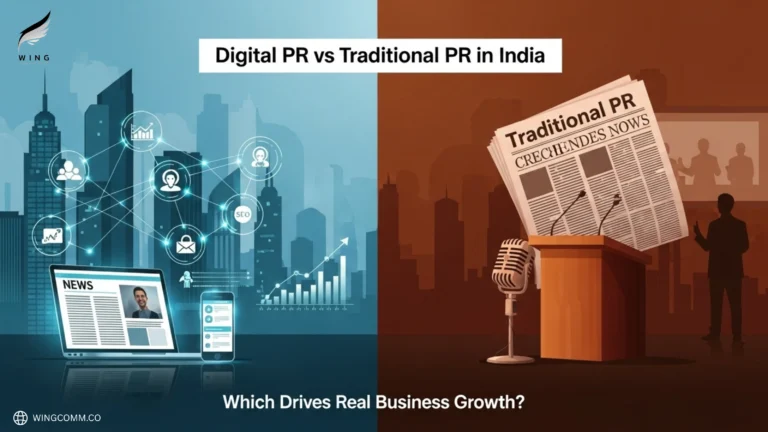
Public relations in India has entered a period of structural change.
What once revolved around press releases, editor relationships, and headline visibility is now shaped by search behavior, digital credibility, and measurable business outcomes.
For leadership teams evaluating PR investment in 2026, the question is no longer whether PR is important — but which model of PR actually contributes to growth.
This article examines the differences between traditional PR and digital PR in the Indian context, and why the distinction matters for modern businesses.
Understanding Traditional PR in the Indian Context
Traditional PR in India has historically focused on:
- Print and broadcast media
- Relationship-led pitching
- Announcements tied to company milestones
- Visibility in legacy business publications
This model played a critical role in establishing credibility, particularly among regulators, institutions, and mature stakeholder groups. Coverage in respected newspapers or television channels still signals legitimacy and stability.
However, traditional PR has inherent limitations in today’s environment. It is largely episodic, difficult to measure beyond reach, and disconnected from how most stakeholders now discover and evaluate brands.
Traditional PR creates awareness — but often lacks continuity and compounding impact.
Book Free Strategy Call
What Digital PR Changes Fundamentally
Digital PR is not an extension of traditional PR channels.
It is a structurally different approach to reputation building.
Digital PR focuses on:
- Online-first publications and platforms
- Earned media that remains discoverable over time
- Search visibility and brand authority
- Data-led storytelling and expert positioning
Instead of measuring success by where a brand appeared, digital PR evaluates what that appearance achieved — in terms of discovery, credibility, and long-term influence.
In essence, digital PR treats reputation as an asset that compounds.
How Brand Discovery Has Shifted
Today, most stakeholders — investors, customers, partners, and talent — follow a similar pattern when evaluating a brand:
- They search online
- They read third-party content
- They assess consistency across sources
- They form trust before engaging directly
Digital PR ensures that this discovery journey is supported by credible, third-party narratives. Traditional PR, by contrast, often disappears from view shortly after publication.
In a market like India, where competition is intense and attention spans are short, persistent visibility matters more than momentary exposure.
Measurement: Where the Gap Becomes Clear
One of the most significant differences between digital and traditional PR lies in measurement.
Traditional PR reporting typically focuses on:
- Coverage volume
- Circulation or reach
- Media logos
Digital PR measures:
- Search visibility impact
- Earned authority and backlinks
- Brand-led search demand
- Narrative consistency over time
For businesses focused on growth, metrics must connect to outcomes — not activity. Digital PR aligns more naturally with this requirement.
The Role of Digital PR in Business Growth
Digital PR directly supports growth by strengthening:
- Brand authority in search ecosystems
- Trust signals used by customers and investors
- Discoverability in competitive categories
- Credibility during scaling phases
When aligned with SEO, digital PR contributes to sustained organic demand rather than short-lived attention. This creates a feedback loop where trust improves visibility, and visibility reinforces trust.
Traditional PR rarely integrates into this growth loop.
Is Traditional PR Still Relevant?
Traditional PR is not obsolete — but its role has narrowed.
It remains effective for:
- Regulatory or institutional communication
- Corporate milestones requiring formal credibility
- Crisis communication where authority matters
However, when used in isolation, traditional PR struggles to support scalable growth. Without digital reinforcement, its impact is limited in duration and difficult to quantify.
Which Approach Drives Real Growth?
Business growth today is driven by:
- Discoverability at scale
- Consistent third-party validation
- Measurable reputation signals
- Long-term authority
Digital PR directly influences all of these.
Traditional PR supports them only indirectly.
For most Indian brands — especially startups, scale-ups, and modern enterprises — digital PR forms the foundation of growth-oriented communication, with traditional PR playing a complementary role.
A Strategic Perspective for Indian Brands
The decision is not between digital PR or traditional PR.
It is about designing a PR strategy aligned with how trust is built today.
Brands that continue to evaluate PR purely on visibility will struggle to see meaningful returns. Brands that treat PR as part of their growth infrastructure — integrated with search, content, and leadership positioning — will compound advantage over time.
Closing Thought
Traditional PR answers the question:
“Where did we appear?”
Digital PR answers a more important one:
“What did that appearance change?”
In 2026, Indian brands that grow sustainably will prioritise impact over impressions, and credibility over coverage.
Because real business growth does not come from being seen once —
it comes from being found, trusted, and remembered.
Proof & Outcomes
Identify when traditional PR adds value—and when it limits growth
See how digital PR supports discovery, trust, and measurable impact
Design a balanced PR approach aligned with modern brand growth
FAQs: Digital PR vs Traditional PR in India
What is the main difference between digital PR and traditional PR?
Traditional PR focuses on legacy media visibility, while digital PR focuses on online discovery, authority, and long-term credibility that compounds over time.
Does digital PR replace traditional PR?
No. Digital PR does not replace traditional PR, but it forms the foundation for scalable growth. Traditional PR works best as a complementary channel.
Why is digital PR more measurable than traditional PR?
Digital PR can be tracked through search visibility, backlinks, brand demand, and referral impact—metrics directly linked to business performance.
Which Indian brands benefit most from digital PR?
Startups, scale-ups, and enterprises competing in crowded or trust-driven markets benefit most, especially in sectors like fintech, SaaS, healthcare, and B2B services.
Book a Free PR Strategy Session
Tell us a bit about your brand and goals. We’ll share a tailored press plan and timeline.